OVERVIEW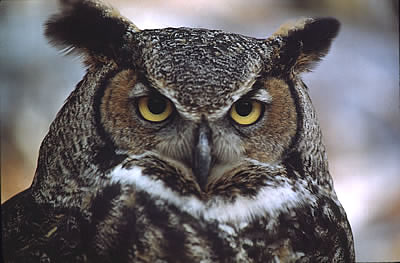
While eagles, hawks, falcons, owls, ospreys and vultures
are collectively termed birds of prey or raptors, this grouping together
reflects traditional classification rather than modern scientific findings.
Taxonomy, which is the process of systematically classifying plants
and animals based upon their relationships to each other, really began
in the 18th century with a hard-working genius named Karl von Linne.
He is usually referred to as Linnaeus,which is the Latin form of his
Swedish name. Linnaeus developed the concept of binomial nomenclature,
the idea of giving plants and animals two names, usually based on Latin
or Greek descriptive words. The first name is an organism's genus name
and the second is its species name. Linnaeus also visualized larger,
related groups he called "orders" and "classes."
Birds of prey were originally lumped together in one group, the Raptores.
Because eagles, hawks, falcons, owls, ospreys and vultures all have
hooked beaks, strong grasping feet, excellent eyesight and masterful
powers of flight, it was once thought that they must be related. Modern
taxonomists recognize a phenomenon called convergence or convergent
evolution, whereby unrelated organisms come ultimately to resemble one
another because they have evolved similar adaptations in response to
similar life demands. Birds of prey therefore are not necessarily closely
related, or even related at all. For example, New World vultures like
the Black Vulture and the Turkey Vulture are related to storks but not
to eagles, hawks and falcons. Owls on the other hand share a common
ancestry with a group of birds known collectively as nightjars. Nightjars
are nocturnal and feed largely on flying insects. Examples found in
New England are the Common Nighthawk and the Whip-poor-will. While owls
and nightjars diverged from a shared line of development millions of
years ago, they are still considered each other's closest relatives,
and owls are not thought to be related to other birds of prey. In fact,
because owls are nighttime hunters they have evolved a host of specialized
features and behaviors that make them unique in the bird world. To focus
on these owlish specialties, we will consider owls separately. For information
on the other birds of prey, see "The Diurnal Birds of Prey: A Very
Mixed Bag" on this Website.
Owls, then, are adapted to hunting at night.
While they are usually termed nocturnal (active at night), many species
are really crepuscular (active at dawn and at dusk). Worldwide there
are between 160 and 175 different owl species. There is some disagreement
about classification, and new owl species have been discovered in recent
years, so the exact number of owl species is hard to pin down precisely.
All owls are classified in one group known as Strigiformes (Strig uh
FORM eez). This large group is subdivided into two families. One family,
which only contains 13 species, includes the barn owls and the bay owls
and is called Tytonidae (ty TON uh dee). The other family is much larger,
because all the other owl species are included in it. This large family
is called Strigidae (STRIG uh dee); the owls included in it are sometimes
referred to as typical owls.
North America is home to 19 owl species. Only one, the Common Barn Owl
(Tyto alba), comes from the Tytonidae family. The other 18 species belong
in the Strigidae family. These 18 North American typical owl species
are:
Flammulated Owl (Otus flammeolus)
Eastern Screech Owl (Otus asio)
Western Screech Owl (Otus kennicottii)
Whiskered Owl or Whiskered Screech Owl (Otus trichopsis)
Northern Pygmy Owl (Glaucidium gnoma)
Ferruginous Pygmy Owl (Glaucidium brasilianum)
Elf Owl (Micrathene whitneyi)
Burrowing Owl (Athene cunicularia)
Boreal Owl (Aegolius funereus)
Northern Saw-Whet Owl (Aegolius acadicus)
Northern Hawk Owl (Surnia ulula)
Long-Eared Owl (Asio otus)
Short-Eared Owl (Asio flammeus)
Spotted Owl (Strix occidentalis)
Barred Owl (Strix varia)
Great Gray Owl (Strix nebulosa)
Great Horned Owl (Bubo virginianus)
Snowy Owl (Nyctea scandiaca)
The eight owl species that are resident to New
England (where the two people who make up the Wingmasters partnership
happen to live) are individually profiled on this Website. Now let's
look at owls' overall structure and see what physical characteristics
(morphology) set them apart from other birds of prey.
FORM
Owls look the way they do because of one overriding fact: they evolved
to hunt rodents during the hours of darkness, when the majority of rodents
are active. That's owls in a nutshell - they are nighttime rodent hunters.
Of course there are many exceptions to this general statement. Some
owls like the Ferruginous Pygmy Owl, the Northern Hawk Owl and the Snowy
Owl routinely hunt by day and are therefore considered diurnal (active
by day). Some owls like the Flammulated Owl are considered insectivorous
(preying upon insects) because insects and arachnids like spiders constitute
their major food source. Several Asian and African species specialize
in hunting fish. Still, these are exceptions that prove the general
rule: most owls, to a greater or lesser degree, hunt rodents in darkness.
Many of the physical characteristics that give owls their unique appearance
stem from this shared lifestyle.
Let's start at the top. Owls have big, wide heads that appear to be
set directly on their bodies without the benefit of a neck. Many species
wear ear tufts, bunches of feathers that sprout from the top of the
head. The huge eyes are set in the front of the flattened face, and
each eye is surrounded by specialized feathers that together form a
facial disk around the face. Other specialized feathers form "eyebrows"
above the eyes. The feathers of the facial disk and eyebrows are paler
than the body feathers, and the facial disk is usually set off by a
rim of differently colored feathers. Hidden behind these specialized,
square-tipped feathers are the ear openings, which may be asymmetrical
(not matching) in size, shape or position.
The upper mandible (beak) is sharply decurved
(curving downward) and partially obscured by stiff bristle feathers
whose overall shape suggests a moustache. The stocky body is held upright
and a rounded look is imparted by dense, loose plumage. Plumage color
is always subdued, usually tones of brown, cream, gray and black.
A perched owl with wings folded gives no hint
of some owlish specializations. One is wings that are very large for
its body weight, wide from front to back as well as from side to side.
The wings' soft upper surface gives owls a uniquely quiet flight. The
characteristically short tail may not show when the owl is perched.
What is obvious on a perched owl (although many
makers of owl toys and collectibles fail to notice this detail and consistently
get it wrong) is that its large feet hold a branch differently from
other birds. Most birds, including the diurnal birds of prey, grip a
branch (or their prey) using three toes in front and one behind. Owls
can move the outside toe of each foot forward or backward, and when
they perch, almost invariably they grip with two toes in front and two
toes in back. Prey seems always to be gripped this way. The legs are
fully feathered and the toes are feathered right down to the talons.
Sometimes the toe feathering is sparse (in the case of the Common Barn
Owl), but more often it is thick. The toes of the Snowy Owl are so luxuriantly
feathered the bird seems to be wearing slippers. The toes are thick
and relatively short, with a gripping power that exceeds that of hawks
and falcons. The talons are more strongly curved than those of other
raptors (with the exception of the osprey).
FUNCTION
Owls don't look the way they do in order to sell toys or nail movie
roles. As we have seen, they have evolved numerous specialized features
to help them hunt primarily rodent prey in low levels of light. So now
let's take a general look at how those specialized features work, and
then we'll move on to detailed descriptions of those features.
The most obvious, most owlish feature of any
owl is the outsized head. The head must be huge because it houses very
large eyes (as large as human eyes in the case of some species, such
as the Great Horned Owl and the Snowy Owl) and very large ear openings.
The eyes must be as large as possible to let in as much light as possible.
The head is wide to allow as much distance as possible between the ear
openings. The face is flattened to give owls, which usually hunt with
the built-in handicap of reduced light levels, a clear field of vision.
The specialized feathers around the eyes are probably aids not to vision
but to hearing, amplifying sound and perhaps channeling sound waves
into the ear openings behind the eyes. The neck, which is hidden under
the dense plumage, actually has more vertebrae than our own necks. All
mammals, from people to giraffes, have seven cervical (neck) vertebrae.
Owls have 14. They're also endowed with flexible neck muscles we lack.
As a result they can rotate their heads 180 degrees from front to back
without moving their bodies. This head movement is necessary because
owls cannot move their tubular eyes more than 1.5 %.
The upper mandible (beak) is angled downward more sharply than is the
case with diurnal birds of prey so it doesn't block its owner's field
of vision. The bristle feathers that surround and obscure the beak are
sensory receptors, just like the vibrissae (whiskers) that sprout from
the muzzles of mammals like cats and dogs. Perhaps the bristle feathers
help owls with close-up situations such as eating.
The upright stance of owls, so different from
the more nearly horizontal posture of most birds, helps these hunters
to watch for prey. Diurnal birds of prey like red-tailed hawks use the
same posture while still-hunting (hunting by perching and waiting motionless
for the movement of prey) and for the same reason - the more upright
the bird, the taller it will be and the more of its environment it can
survey. Perched this way, owls have a distinctly rounded look because
of their densely layered, fluffy plumage. Owls actually have more feathers
than many other types of birds. As many as 10,000 feathers of various
kinds cover their heads and bodies, even unlikely places like eyelids.
With most owls species, the only skin surface not covered by feathers
is the underside of the feet. One reason for the extra feathers is that
owls typically hunt when the sun is down, whether they are truly nocturnal
or (more often) crepuscular. When the sun goes down, so do temperatures,
particularly in wintertime. Owls therefore need protection from the
cold, and they achieve it with extra feathers to hold in body warmth.
Because they are in large part rodent hunters, preying on animals that
can bite hard (the word rodent comes from a Latin word that means "to
gnaw"), they must catch and dispatch their prey before it has the
chance to bite them. So owls have evolved feathers with a velvety upper
surface that do not rustle as the feathers rub against each other. The
soft-surfaced feathers on owl wings muffle the sound of air flowing
over the wings. On most owls species the outermost primary feather of
the wing has a saw-toothed leading (front) edge, a stiff row of filaments
called fimbriae that looks like they've been spiked with hair gel. The
second primary feather has a much shorter saw-toothed edge, and the
rest of the wing feathers lack this specialized feature. However, the
tips and trailing (back) edges of owl primary feathers and secondary
feathers (the major flight feathers of the wing) are soft, with a fringe
that gives them a somewhat ragged look compared to the crisp edges of
a falcon or eagle wing feather. These two wing-feather refinements -
a spikey leading edge and soft, ragged edges on the feather tips and
backs - help to silence the passage of air over the wing surface and
so enable owls, uniquely in the avian (bird) world, to fly almost soundlessly.
Owl wings are large for the birds' weight (which
is never as great as it seems; remember that owls are wrapped in extra
layers of soft feathers that give them a deceptively heavy look). Birds
like owls that have a big wing surface and a relatively low weight are
said to exhibit low wing-loading. Birds like falcons that have a smaller
wing surface and relatively high weight are said to exhibit high wing-loading.
The owls' low wing-loading means two things: they don't have to flap
their wings as often as birds like falcons, yet another contributor
to quiet flight; and they can fly off with heavier prey than a bird
with high wing-loading.
So owls have evolved several methods for cutting down on noise as they
fly, and this virtually silent flight allows them to sneak up undetected
on their prey. There is one more reason that owls fly quietly. Owl hearing
is the best in the world (at least it is in some species, notably the
Common Barn Owl), and many owls locate their prey largely by listening.
How would it benefit owls to have this superior auditory ability if
they made a noise as they flew? So owls have evolved uncannily quiet
flight to help them hear their prey and to prevent their prey from hearing
them.
Owl plumage is never brightly colored. The brilliant
hues of male songbirds like cardinals, goldfinches and orioles is not
present in any owl species. The question we should ask about their cryptically-colored
(colored to conceal) plumage is this: Why is it necessary? Owls' ability
to fly virtually soundlessly means that they can aerially ambush their
prey without the benefit of camouflage. So why are owls colored and
patterned to blend in with their surroundings? The answer lies in a
phenomenon known as mobbing. Birds of prey are understandably feared
by other birds; they represent a real or implied threat to those other
birds. In response to this threat, passerines (songbirds) will gang
up on a raptor, vocalizing to one another using an alarm call that is
understood by many different kinds of birds. Some particularly aggressive
species such as crows, blue jays and mockingbirds will even attack the
predator, although the real intent of mobbing is probably not to hurt
but to harass and drive away. While all raptors are the targets of mobbing
behavior (which means that raptors have recognizable raptorial characteristics
that identify them as such to other birds), owls seem to be marked out
for particularly intense mobbing from passerines. The reason for this
is probably that owls represent a greater threat to passerines than
other raptors, because owls can see and navigate in the dim, dark hours
when passerines are helpless. Owls can and do help themselves to songbird
snacks at night, and songbirds by instinct know this. So by day the
songbirds will frantically mob any owl they find, using the advantage
of greater numbers. If the mob includes some murderously inclined crows
the consequences to the owl may be fatal. So owls hide by day, using
their camouflage (and any tree cavity that's handy) to conceal themselves
from avian vigilantes.
The thick, strong toes of owls exert a tremendously
powerful grip. For their own safety, owls need to subdue their prey
as quickly as possible, particularly if their prey is a rodent that
can turn and bite. The unusually powerful grasping ability of owl feet
accomplishes two things simultaneously - the rodent is held immobilized
in the viselike grip; and the toes drive the dagger-sharp talons into
the prey, quickly ending its life. The strong curve of their talons
(Great Horned Owl talons, for example, are curved in a full half-circle)
helps owls to maintain their grip. So does the zygodactyl (two toes
in front, two toes in back) arrangement of their toes. The two-in-front,
two-in-back toe arrangement also enables owls to lift greater weights
proportionately than other birds of prey, since the weight is evenly
distributed.
The powerful owl foot grip is necessary partly
because of something owls in general don't have, and that's speed. Falcons
and eagles in particular often use a speedy, wings-closed dive known
as a stoop to either knock prey out of the air or bowl it over on the
ground. Their speed allows these raptors to take down prey larger than
themselves. Owls, by contrast, usually capture their prey on the ground
after a short glide from a nearby tree. They are not built for speed
and (with the exception of a few species like the Northern Hawk Owl
and the Snowy Owl) rarely achieve it. So they depend upon a powerful
grasp, applied without the benefit of a speeding blow.
The feathering on owl legs and toes helps quiet their movement as they're
swung down like the landing gear of a plane, ready to grab. The feathering
also helps protect owls from the bites of their prey. It's often written
that the feathering on owl toes is a protection against cold. That may
be true, at least in part - northern species like the Northern Saw-Whet
Owl and the Snowy Owl sport very heavily feathered toes, while the Common
Barn Owl, with a more southern distribution, has sparsely feathered
legs and toes. However, I'm inclined to think that owls need feathered
legs and toes as much for protection from bites as for protection from
cold temperatures.
|